Some Colorado politicos were surprised when state Sen. Greg Brophy failed to generate enough support to make the Republican ballot for Governor last weekend, but it makes plenty of sense when you consider recent electoral history in our state. Brophy hails from Yuma County in Eastern Colorado, an area that is home to only about 10,000 residents. Brophy may have had the support of Republican delegates from Yu
ma County, but that number would be just a fraction of the votes he needed at the GOP State Convention.
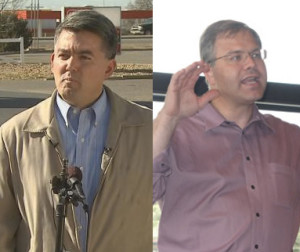
Congressman Cory Gardner, the GOP nominee for U.S. Senate, is also from the Yuma area. Gardner succeeded Brophy in the State House when the latter was appointed to the State Senate in 2005. Gardner had no trouble winning the GOP nomination for Senate last weekend, primarily because he did not face the same crowded field of gubernatorial candidates that stood in front of Brophy. But Gardner still needs to figure out how to solve what we’ll call his “Yuma Problem” if he hopes to win a General Election matchup with Senator Mark Udall…and history is not on Gardner’s side.
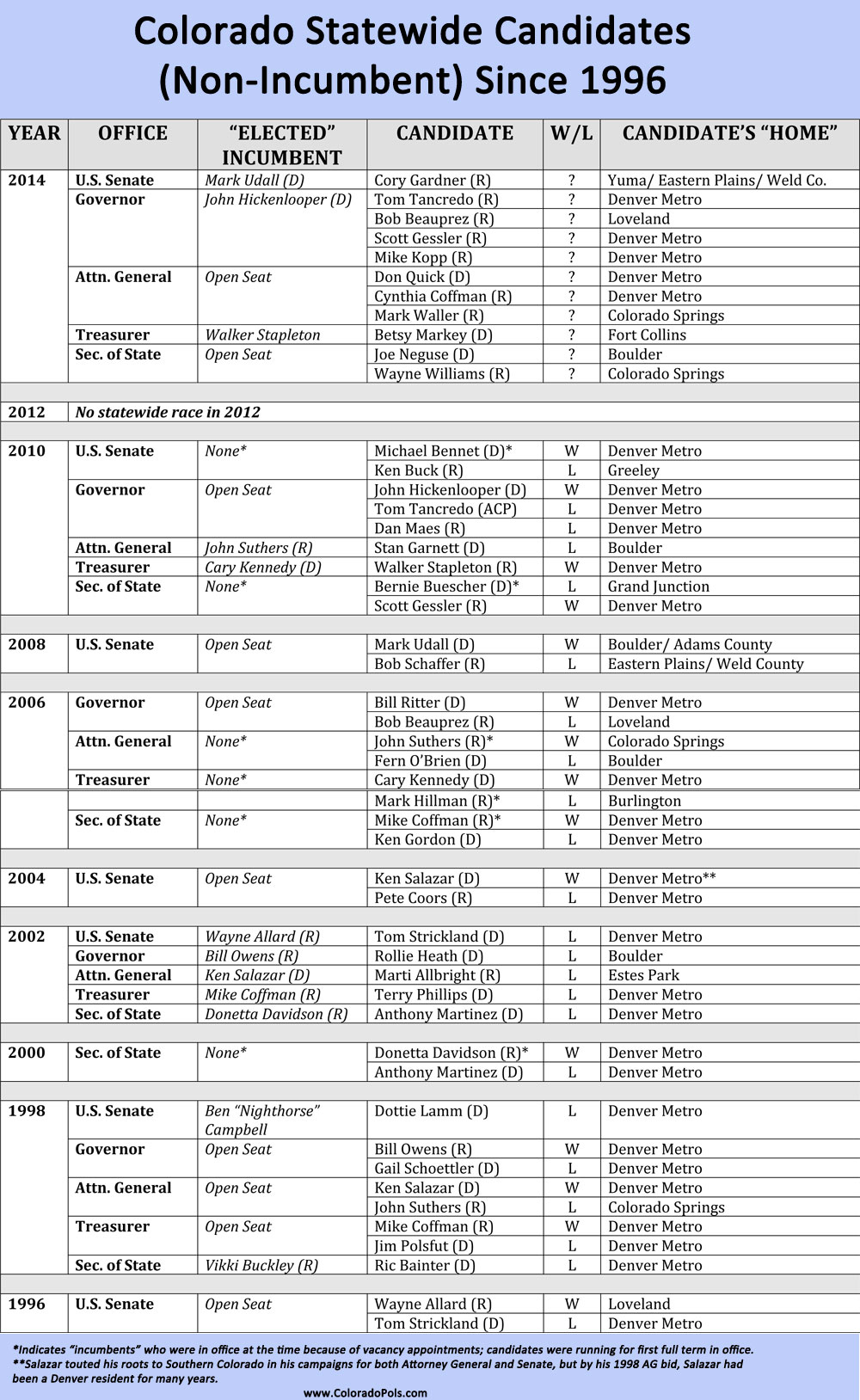
The last time Colorado voters elected a statewide candidate who did not hail from the Front Range of Colorado? That was in 1996, when Loveland-based Rep. Wayne Allard was first elected to the U.S. Senate (Loveland was much smaller in 1996 than it is today — the population has doubled since the 1990 census).

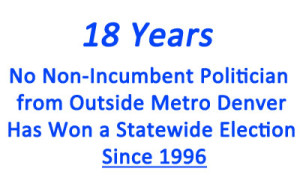
It has been 18 years since Colorado voters last elected a non-incumbent candidate who did not have roots along the Front Range, and particularly, the Denver Metro area.
Check out the numbers from the 2012 election, when a total of 2,584,719 ballots were cast in the race for President. Nearly 80% of those votes came from the Front Range of Colorado, between Ft. Collins and Pueblo. More than 1 million votes were cast in just four Denver Metro counties: Adams, Arapahoe, Denver, and Jefferson.
There was a time in Colorado when grizzled political veterans of any political party agreed on one thing: That a Denver-based politician could never win a statewide office. That old yarn was repeated as recently as 2006, finally dying out for good when former Denver District Attorney Bill Ritter was elected Governor.
Population shifts in Colorado over the past 20 years have dramatically altered the landscape of statewide politics, to the point where the old saying about Denver politicians has been flipped on its head. In fact, it may no longer even be possible to win a statewide race if the candidate is not from the Denver Metro area – or at the very least, from somewhere along the Front Range.
With so many media outlets concentrated on the Denver Metro area, local politicians have a significant advantage when it comes to earned media and building name recognition. It’s difficult for a rural Congressman such as Gardner to generate name ID when the Greeley Tribune is the largest media outlet in his district.
You’ll hear a lot of different statistics and historical patterns around the 2014 election, including predictions based on how candidates typically fare in the 6th year of a Presidency. But this Colorado pattern is more than a trend – it represents a fundamental shift in the electorate that would be difficult for any candidate to overcome. Check out our graphic of all statewide candidates since 1996 after the jump…
Subscribe to our monthly newsletter to stay in the loop with regular updates!
Comments