U.S. Senate See Full Big Line

(D) J. Hickenlooper*

(D) Julie Gonzales

(R) Janak Joshi

80%

40%

20%

(D) Michael Bennet

(D) Phil Weiser
55%

50%↑
Att. General See Full Big Line

(D) Jena Griswold

(D) M. Dougherty

(D) Hetal Doshi

50%

40%↓

30%

Sec. of State See Full Big Line
(D) J. Danielson

(D) A. Gonzalez
50%↑

20%↓
State Treasurer See Full Big Line

(D) Jeff Bridges

(D) Brianna Titone

(R) Kevin Grantham

50%↑

40%↓

30%

CO-01 (Denver) See Full Big Line

(D) Diana DeGette*

(D) Wanda James

(D) Milat Kiros

80%

20%

10%↓

CO-02 (Boulder-ish) See Full Big Line

(D) Joe Neguse*

(R) Somebody

90%

2%

CO-03 (West & Southern CO) See Full Big Line

(R) Jeff Hurd*

(D) Alex Kelloff

(R) H. Scheppelman

60%↓

40%↓

30%↑

CO-04 (Northeast-ish Colorado) See Full Big Line

(R) Lauren Boebert*

(D) E. Laubacher

(D) Trisha Calvarese

90%

30%↑

20%

CO-05 (Colorado Springs) See Full Big Line

(R) Jeff Crank*

(D) Jessica Killin

55%↓

45%↑

CO-06 (Aurora) See Full Big Line

(D) Jason Crow*

(R) Somebody

90%

2%

CO-07 (Jefferson County) See Full Big Line

(D) B. Pettersen*

(R) Somebody

90%

2%

CO-08 (Northern Colo.) See Full Big Line

(R) Gabe Evans*

(D) Shannon Bird

(D) Manny Rutinel

45%↓

30%

30%

State Senate Majority See Full Big Line

DEMOCRATS

REPUBLICANS

80%

20%

State House Majority See Full Big Line

DEMOCRATS

REPUBLICANS

95%

5%

Generic selectors
Exact matches only
Search in title
Search in content
Post Type Selectors
March 08, 2020 09:29 AM UTC

Caucuses: That Weird Increasingly Irrelevant Thing We Do

  •  
  • by: Colorado Pols
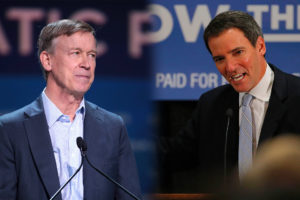
John Hickenlooper, Andrew Romanoff. RIP our mentions.

As the Denver Post’s political team reports, Colorado Democrats and Republicans held their precinct-level caucuses yesterday afternoon, which traditionally mark the start of full-scale organizing for primary candidates well in advance of the parties’ primary elections–formerly in August, more recently moved up to June to give nominees time to make an unfettered case. And yesterday afternoon, as widely expected, not-quite perennial candidate Andrew Romanoff came out on top in the Democratic U.S. Senate race–by a similar margin as his Senate caucus win almost exactly a decade ago in 2010:

Andrew Romanoff claimed to have won a grassroots victory Saturday as he led John Hickenlooper, his better-funded and better-staffed rival for the U.S. Senate, in statewide caucuses of Colorado Democrats.

Romanoff, a progressive favorite, won 55% of the raw vote and Hickenlooper won 31% with 55 of 64 counties, including Denver, reporting late Saturday, according to the Colorado Democratic Party. However, several counties will not report their results or the number of delegates won by candidates until Sunday.

Precinct caucus results will determine the number of delegates that candidates have at upcoming county caucuses. Results there will determine delegate counts at an April 18 state assembly, where candidates will need at least 30% support to have their names placed on June 30 primary ballots.

Precinct caucuses have long been a fixture of party organizing in Colorado, where partisan candidates for office at all levels face their first public test. For those so inclined, the precinct caucuses are the first step toward moving up the volunteer side of the party apparatus. What they are not historically, however, are good predictors of a party’s eventual nominee in the big races. Cary Kennedy defeated now-Gov. Jared Polis handily in the 2018 caucuses, Romanoff himself bested now-Sen. Michael Bennet in 2010 by an almost identical margin as last night’s, and in 2004 the now-forgotten Mike Miles beat out former Interior Secretary Ken Salazar.

With respect to Romanoff’s win yesterday, his language compared to 2010 is more or less interchangeable.

In a news release, Romanoff declared victory, calling the results a “shock wave” and said they reflect voter resentment of Washington politics and the big-money interests that contribute to it. The latter is a not-so-subtle shot at Bennet’s campaign coffers, which dwarf Romanoff’s.

“We’re very encouraged by these results,” Romanoff said. “This is the first chance Main Street has had to weigh in. We’ve already heard from Washington and Wall Street.”

And last night,

“Our grassroots campaign just crushed the D.C. machine and won today’s caucuses!” Romanoff told supporters around 7:30 p.m. “The power brokers and party bosses in Washington didn’t get the memo, but it turns out a lot of people in Colorado want to replace Cory Gardner with a progressive champion.”

Turnout reportedly suffered at yesterday’s caucuses compared to previous years, attributable to the switch to a presidential primary election after Proposition 107 was enacted to prevent a repeat of Bernie vs. Hillary caucus chaos in our state in 2016. The combination of reduced interest in precinct caucuses confusingly held right after a much higher-profile primary election, the ease by which the caucus process can be bypassed by petitioning directly on to the ballot, and the recent irrelevance of the caucus process in determining the eventual winner do present a reasonable argument for a change in the way(s) Colorado political parties nominate their candidates.

On the question of irrelevance, it’s not necessary to take our word for it. Politico had it right on March 17th, 2010:

Recent Colorado history shows that a caucus victory usually doesn’t translate into the party nomination. Over the past four decades, just three statewide candidates who have won the backing of the state assembly, after the caucus process, went on to become their party’s nominee. [Pols emphasis]

Historically, the only tangible benefit from winning the caucuses, the bragging rights and associated perception of campaign momentum, have not materialized for candidates who have put all their eggs into doing so. Events like the 2016 Colorado caucus near-breakdown and the full-scale implosion at the Iowa presidential caucus in January help feed the public perception that caucuses are a dysfunctional, undemocratic anachronism. The fundamentals of the Democratic U.S. Senate primary, pitting a vastly better-known and better-funded frontrunner against a vitriolic but overmatched opponent, have not changed.

Sometime after June 30th, perhaps we can revisit this issue dispassionately.

Comments

Recent Comments


Posts about

Donald Trump
SEE MORE

Posts about

Rep. Lauren Boebert
SEE MORE

Posts about

Rep. Gabe Evans
SEE MORE

Posts about

Colorado House
SEE MORE

Posts about

Colorado Senate
SEE MORE

69 readers online now

Newsletter

Subscribe to our monthly newsletter to stay in the loop with regular updates!