Following up on a story we posted last Friday, in which the Colorado Senate GOP majority blocked what should have been the routine re-appointment of Heidi Hess as chair of the Colorado Civil Rights Commission–as the Denver Business Journal’s Ed Sealover reports on the confusion and finger-pointing in the wake of their decision:
Colorado Senate Republicans rejected a proposed appointee to the Colorado Civil Rights Commission today, a rarely used blockade that was done after business groups complained about not having a voice on the board.
Heidi Jeanne Hess of Clifton, a West Slope organizer for the LGBTQ advocacy group One Colorado, had served on the commission since 2013. Records show that she was appointed as at-large member in 2013 and nominated for reappointment in March by Gov. John Hickenlooper as a member of the community at large…
As we reported on Friday, LGBT advocacy group One Colorado reacted with anger to Hess’ rejection, saying the move by Senate Republicans reaffirms why “LGBTQ discrimination continues to exist, even in the branches of our own government.”
But as the Grand Junction Sentinel reported Saturday, Republicans claimed in response to questions that their retaliation against Hess had nothing to do with the fact that she is openly lesbian and an employee of One Colorado:
The rejection of a governor’s appointment came as a surprise for most, since such things rarely occur regardless of what party controls the governor’s office.
Sen. Jerry Sonnenberg, R-Sterling, said he recommended rejecting Hess because she was listed as a representative for small business on the commission, [Pols emphasis] but had recently advocated against business interests…
On the floor of the Senate on Friday, Sonnenberg made a motion to vote on Hess’ reappointment, recommending a “no” vote, saying she supports legislation promoting ways to sue employers.
So the objection to Hess appears to stem from the passage in 2013 of House Bill 13-1136, legislation that extended the same discrimination protections already covering most employees in federal law to employees of small businesses. As an organizer for One Colorado, Hess would have naturally supported that bill along with just about every other activist and group working on workplace discrimination issues.
But there’s still another twist–Sealover:
Until recently…the commission’s website had listed her as the business representative to the board, although she worked for a nonprofit advocacy group. State-government representatives confirmed Friday afternoon that was an error.
Tony Gagliardi, Colorado director for the National Federation of Independent Business, said he inquired how Hess could speak for the business community and found that the website soon listed her instead as a community member at large. But when she was slotted for reappointment this year, he and at least one other business group questioned legislators about what role she would fill…
“The governor has shuffled the commission around to get what had been the business seat moved to someone else,” Sonnenberg complained before GOP senators voted 18-17 over objections from Democrats to reject Hess.
The Sentinel corroborates the apparent case of mistaken identity:
The root of the problem appears to be some confusion about which interest Hess represents on the commission. The seven-member panel has two business representatives, two local government representatives and three representing the “community.” [Pols emphasis]
On the commission’s website, Hess is listed as an at-large community representative, but that same website just days before her confirmation hearing listed her as the small business representative, Sonnenberg said.
Hess is not a business owner, and that point bothered Sonnenberg and Hill, the other Republican who voted against her in committee.
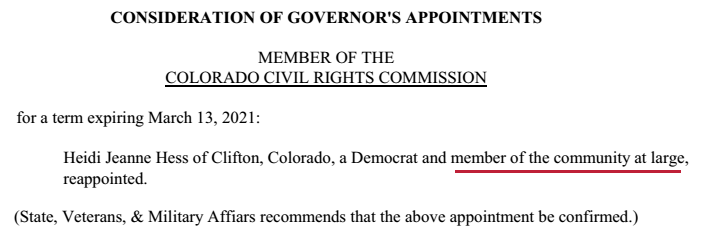
It’s true, Hess is not a business owner, and it would be inappropriate to appoint her to a seat on the commission intended for the “business community.” But that’s not a problem, since the Civil Rights Commission already has two appointed members representing business as the law requires–Carol Fabrizio and Rita Lewis. We can’t explain any error in Hess’ description on the Commission’s website, but the law is clear on how many people from each interest group are to be appointed. And the Senate calendar from Friday was not in error:

Bottom line: one of two things happened here. The first possibility is that Senate Republicans and business lobbyist Tony Gagliardi simply messed up. They saw the mistaken listing of Hess as a “business representative” on the Commission, and decided based on that to retaliate against her over a bill passed into law four years ago. For this to have been a legitimate error would have required multiple Republican lawmakers and a veteran lobbyist to not understand the makeup of the Civil Rights Commission, and to not seek any clarification of this erroneous listing before taking action against her. It would also require them to have not read the Senate calendar which clearly identified Hess not as a “business representative,” but as a member of the community at large.
So that’s the first possibility. The second is that they knew exactly who she was, what her job was, and why she was appointed to the Civil Rights Commission. And they targeted her anyway. And although this would betray some pretty serious malice on the part of Republican lawmakers, entirely likely tinged with anti-LGBT bigotry, it would not make them all look…well, you know, like complete idiots.
Which one is it? Neither one makes them very good, of course. But one is definitely worse than the other.
Subscribe to our monthly newsletter to stay in the loop with regular updates!
Comments