Long a beet-red conservative Republican befitting beet-red Eastern Plains constituencies, Colorado’s junior Sen. Cory Gardner ran to the center to narrowly oust incumbent Democratic Sen. Mark Udall last year. Gardner’s audacious repositioning as a centrist candidate was essential to avoiding the fate of Gardner’s successor in Congress, Ken Buck–who lost 2010’s Senate race against appointed incumbent Democratic Sen. Michael Bennet by refusing to jettison his load of unsightly right-wing baggage.
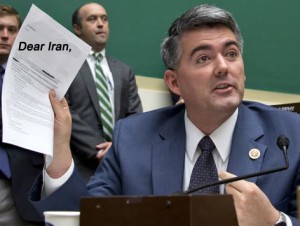
Since taking office, Gardner has made a few votes that managed not to offend the sensibilities of voters who were lured by his centrist message, like voting with Democrats against to protect Wilderness Study Area public lands. But in the critical arena of foreign policy, Gardner misstepped badly when he joined 46 other Republican Senators in an ill-advised letter to the government of Iran attempting to undermine multinational negotiations to halt that nation’s nuclear weapons program. The widespread backlash over that letter surprised its signers, some of whom even admitted after the fact that it was a bad idea.

Last week, the long-awaited agreement between Iran and the so-called “P5+1” nations–the United States, Russia, China, France, the United Kingdom, and Germany, as well as diplomats representing the European Union as a whole–was finally announced. By most accounts, it’s a good deal. Nicholas Burns, a former Undersecretary of State for George W. Bush, calls it “a sensible step forward for Iran and the west.”
Ten years in the making, the framework nuclear deal announced on Thursday in Lausanne makes it reasonable to hope that a final written pact can be hammered out by the summer, preventing Iran from obtaining a nuclear weapon…
Speaking at the White House, Mr Obama set the bar high. Iran’s once flourishing uranium enrichment industry would be subject to strict limits at every stage, closing Iran’s path to a bomb. Another route, to a plutonium bomb, would be blocked by dismantling the core of the heavy water reactor at Arak. Iran’s commitments would be policed by intrusive international inspections, and many of the sanctions that have degraded its economy would be lifted only if Tehran complies at every step.
There’s a pretty good case to be made that Cory Gardner squandered his credibility on Iran when he signed a letter attempting to directly interfere with these critical multinational negotiations. There was no official statement from Gardner in the immediate aftermath of the announcement Thursday of the deal, but in today’s Denver Post, Gardner has a guest opinion column on the subject. It’s striking to us that Gardner makes no mention of the controversial letter to Iran’s government he signed, but the over-the-top xenophobic rhetoric in this op-ed takes the questions about Gardner’s foreign policy credentials to a new level either way:
The administration has attempted to present the American people with a choice: either war with Iran, or a bad deal that does little to stop Iran from acquiring a nuclear weapon. This is a false choice, and should be rejected. This framework, based on details released thus far, appears to leave vast portions of Iran’s nuclear infrastructure intact, remove all sanctions on Iran, and give the mullahs a get-out-of-jail-free-card to build all the nuclear weapons they want in as few as 10 years. Fearing that Congress would rightfully reject such a terrifying deal, the administration has preferred to take its case to the unelected bureaucrats of the United Nations, instead of the elected representatives of the American people.
There’s no nice way to say this: Gardner’s description of the agreement between Iran and the P5+1 coalition, basically the most powerful nations in the world including the United States, is so far from accurate it’s grossly irresponsible. For one thing, the relaxation of economic sanctions on Iran is based on Iran’s compliance with the agreement. There’s no giveaways to Iran here, what they get is based on their actions to stop developing nuclear weapons. But above all, what this amounts to is Gardner vilifying President Barack Obama as a proxy for the rest of the world: France, the United Kingdom, Germany–and yes, Russia and China too. Are we really supposed to believe that all these other nations want Iran to get the bomb? It must take an awful lot of blind Obama hatred to buy the case Gardner is making–and that’s before he invokes the dreaded blue helmets of the United Nations.
Al of this is further confirmation of what the Iran letter controversy already indicated: on foreign policy, an issue Sen. Gardner has a major role in as a member of the Senate Foreign Relations Committee, bush-league fearmongering is our new Senator’s stock and trade. That’s a profound disappointment for any of you still hoping for “A Different Kind of Republican™.”
Subscribe to our monthly newsletter to stay in the loop with regular updates!
Comments