The Colorado Statesman’s Vic Vela has a story up today about the long-term shortage of federal funds for transportation projects, and what that’s forcing states like Colorado to do to provide for the infrastructure needed to sustain economic growth–not to mention keeping your commute from driving you totally insane:
Congress faces a July 31 deadline to pass legislation addressing the country’s transportation needs. But recent history suggests lawmakers will fall short of passing a long-term funding bill, instead opting for yet another stopgap measure.
Over the last six years, Congress has passed short-term transportation funding extensions 33 times.
The temporary funding measures are unsustainable, Mendez said, if Congress intends to repair roads and bridges…
[Deputy Transportation Secretary Victor Mendez] called on Congress to take action on the Grow America Act, a six-year, $478 billion highway funding bill supported by President Obama and Mendez’ boss, Transportation Secretary Anthony Foxx.
According to Deputy Secretary of Transportation Victor Mendez, passage of the Grow America Act would bump Colorado transportation funding up 20%, with an even bigger increase for transit projects. As you can imagine, though, the measure is going nowhere in the Republican-controlled Congress:
“There’s difficulty getting it through the Republican House right now, which is sort of par for the course,” said Democratic Rep. Ed Perlmutter, who represents the 7th Congressional District.
The U.S. Senate has introduced a more modest bipartisan proposal, cosponsored by GOP Sen. Cory Gardner, that would increase transportation funds by a smaller amount via a relatively gimmicky incentive for corporations to repatriate overseas earnings at favorable tax rates. Anything would help, of course, but the huge long-term deficit in funding for transportation projects, both to maintain current infrastructure and to provide for the future, is much bigger than what Gardner’s bill would provide for.
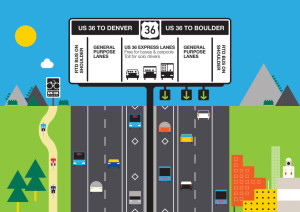
But there’s another big difference between the two proposals: the President’s bill relies on provisions that Coloradans may not like, even though they are being embraced by cash-strapped Colorado transportation officials right now. The Grow America Act would significantly ease restrictions on tolling of existing interstate highways, as well as encourage so-called “public-private partnerships” to build new transportation projects. In Colorado, the new U.S. 36 Express Lanes Project is an example of what the future would look like under the Grow America Act–new infrastructure, but at a significant long term cost and loss of control:
The massive U.S. 36 Express Lanes Project is an example of that kind of funding. In fact, it’s Colorado’s first-ever public-private funding partnership.
The $500 million project will bring express lanes, bus rapid transit and a commuter bikeway that will connect Denver to Boulder…
Hickenlooper acknowledged that it might take some time for motorists to accept the reality of having to pay to drive on a metro area highway they frequent. [Pols emphasis]
You’ll recall that the agreement between the state and the private consortium Plenary Roads Denver for the U.S. 36 toll lanes was highly controversial, but under Colorado’s legendary fiscal constraints, and with nothing but stopgap temporary transportation measures passing in Washington, Gov. John Hickenlooper argued successfully that it was the only way to get the project built. Unlike President Obama’s Grow America Act, the bipartisan Invest In Transportation Act doesn’t encourage more such public-private partnerships–just providing a new revenue source for the federal Highway Trust Fund.
Bottom line? President Obama faces enormous obstacles getting any kind of comprehensive transportation funding plan through Congress. The Grow America Act would raise revenue by a significant degree, but would further embrace controversial public-private partnerships and reviled toll roads in order to get there. The real issue here is the lack of political will to raise taxes to properly fund these desperately needed projects, and you can’t really blame Obama for that.
What’s the solution? In the short run, it’s quite possible that Gardner’s bill is the better answer–especially if you oppose the funding gimmicks and private-sector giveaways we’re seeing with the U.S. 36 toll lanes. Obama is doing what he can with the constraints placed on him by a hostile Congress–a situation not altogether dissimilar from Colorado’s artificially cash-strapped reality under the Taxpayer’s Bill of Rights (TABOR). But in the long term, legitimizing broad expansion of tolling and Faustian private-sector deals to fund road projects is a troubling prospect.
“No one likes to pay a toll,” [Hickenlooper] said. “Nobody likes it. I can’t stand it. But I also don’t like being stuck in traffic for an hour or two. And right now people don’t want to raise their taxes, so having a tollway is the best way to get this infrastructure built.”
It would be wrong to blame Hickenlooper or other reluctant supporters of the U.S. 36 model for doing what they have to do, since they are making the best of limited resources. To his credit, Hickenlooper has become increasingly vocal about loosening the constraints imposed on our state by the TABOR and other competing constitutional fiscal mandates and limits.
In the end, at least for Colorado, therein lies the answer for building our infrastructure. Depending on what happens in Washington, maybe the only answer.
Subscribe to our monthly newsletter to stay in the loop with regular updates!
Comments