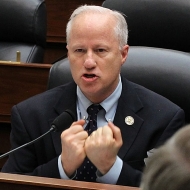
With last week’s terrorist attack in Paris, France still dominating the news today, we wanted to take a closer look at the statements of Colorado’s foremost member of Congress on matters of foreign policy, Rep. Mike Coffman, and figure out what his position on how best to confront the so-called Islamic State in Iraq and Syria, you know, really is. Over the weekend, Coffman made it clear that he blames the Obama administration in some measure for the Paris attacks:
“This is what the world looks like without American leadership.” – @RepMikeCoffman on @FoxNews. #ParisAttacks #ISIS
— Steffan Tubbs (@TubbsKOA) November 14, 2015
Looking back at Coffman’s public statements as the civil war in Syria slowly evolved into a multinational war against ISIS, though, it’s a lot harder to understand exactly what Coffman means in terms of the United States failing to show “leadership.” In fact, President Barack Obama has apparently tried to do just that on numerous occasions, but Coffman’s response has consistently been to oppose Obama’s actions–even at the risk of contradicting himself. Back in 2013, Coffman was interviewed by the Denver Post’s Tim Hoover on the subject of intervening militarily in Syria:
On this week’s edition of The Roundup, editorial writer Tim Hoover interviews U.S. Rep. Mike Coffman, R-Aurora. Coffman explains why he has so far opposed military intervention in Syria, calling the conflict an “intractable” and “sectarian” civil war…
In January of 2014, as ISIS began to loom larger than the pariah Syrian government as a threat, Coffman told local radio host Dan Caplis he would not support anything beyond advisors to combat either:
Certainly an advisory role, but certainly not anything beyond that. And that’s if requested. I think we have to be very careful once out about reentering that particular conflict. I would say, in terms of regular troops on the ground, absolutely not.
Then in June of 2014, Coffman again urged President Obama not to send even advisors to assist the Iraqi Army fighting against ISIS:
Today, U.S. Representative Mike Coffman sent a letter to President Barack Obama requesting that he suspend sending any U.S. military personnel to assist the Iraqi Army until the U.S. is successful in putting pressure on the Iraqi government to establish a process of political reconciliation with the disaffected Sunni Arab and Kurdish minority populations in Iraq. Last week, President Obama put forward a plan to send up to 300 U.S. military advisors to assist the Iraqi army and to assess the situation on the ground with the Iraqi army and their ability to fight Islamic State of Iraq and Syria (ISIS) led opposition forces. Coffman is a Marine Corps combat veteran and is the only member of Congress to have served in both Iraq Wars.
“The only feasible solution is a political reconciliation. Any further U.S. military assistance must be strictly preconditioned on a fundamental change in the Iraqi government, which will send a clear message to both the Sunni Arabs and the Kurds that they will have a voice in the formation of a new government and their respective provinces will receive an equitable distribution of the oil wealth of the country,” wrote Coffman in his letter.
But by September of 2014, Coffman had turned hawkish once again, claiming without much elaboration that President Obama had done “too little” to “take the fight” to ISIS:
“President Bush did too much, getting us involved in a costly and unnecessary occupation, but President Obama has done too little to take the fight to those who seek to do us harm. [Pols emphasis] I agree with President Obama that a political solution is necessary to dismantle ISIS and know how hard that will be from my time in Western Iraq with the Marine Corps in 2005 and 2006. But we have ignored this threat for far too long. We cannot continue leading from behind.”
A day later, Coffman appeared to contradict himself once again in an interview with Bloomberg News:
“There has to be a political solution; there’s not a military solution alone for this,” Representative Mike Coffman, a Colorado Republican, said in an interview today with Bloomberg Television. He said he doesn’t support U.S. troops on the ground.
By February of this year, though, Coffman was changing his tune again. Are we the only ones who smell an “evolving” position that is consistent only insofar as it is inversely proportional to the Obama administration’s position?
Certainly, as an Iraq war veteran, I wouldn’t want to see U.S. forces on the ground as the maneuver ground element. I want I want to see indigenous forces on the ground, but we’re going to need special operators from time to time to take out high-value targets. We are going to need to give them air logistical and advisory support, and that is going to take some elements of boots on the ground. [Pols emphasis]
Bottom line: what we see from Coffman in his “evolution” on confronting ISIS is not a well thought-out process, but an opportunistic game meant to oppose whatever the Obama administration supports at any given time. There is no question that Coffman has opposed taking military action against ISIS in the past, even opposing reinforcing the Iraqi government with American advisors as you can plainly read above. If Obama announced today, for example, that he was sending more advisors to help the Iraqis fight ISIS, it’s easy to see Coffman going right back to complaining.
Because Coffman’s statements appears to only be consistent in that they oppose Obama. There’s nothing you can extract from Coffman’s own statements on this issue that even look coherent, let alone like “leadership.”
As much as any other angle, that should be the story whenever Coffman opens his mouth.
Subscribe to our monthly newsletter to stay in the loop with regular updates!
Comments