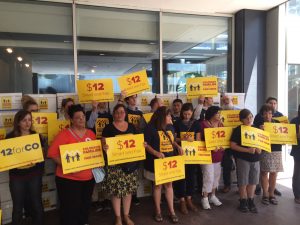
A press release from Colorado Families for a Fair Wage announces their submission of over 200,000 petition signatures in support of their ballot measure to raise the minimum wage in Colorado to $12 an hour by 2020–more than double what was needed to qualify for the ballot in November:
Today, a coalition of business owners, workers and supporters with Colorado Families for a Fair Wage delivered boxes containing petitions with 200,000 signatures to place a ballot initiative that will raise the Colorado minimum wage to $12 by 2020 on the November ballot. The 200,000 signatures is more than double the 98,492 signatures needed to qualify, showing overwhelming support for the measure.
“It’s clear our measure to raise the minimum wage to $12 by 2020 will be on the November ballot,” said Patty Kupfer, Colorado Families for a Fair Wage campaign manager “Raising the minimum wage is fair and smart. It’s fair because people working full time should earn enough to support their families. It’s smart because when working people have more money in their pockets, they spend it here in Colorado, boosting our economy and helping our communities thrive.”
The average age of a minimum wage earner is 35 – and more than 86 percent of minimum wage earners are over the age of 20. A full-time minimum wage worker takes home less than $300/week, not nearly enough to afford food, rent and other basic needs. In Colorado, a minimum wage worker needs to work 80 hours per week to afford a basic two bedroom apartment.
“Even though I work full-time as a nursing assistant, I can’t afford to support us without public assistance,” said Marrisa Guerrero, a mom raising a school-age daughter. “We have no choice but to rely on subsidized housing, can’t afford health insurance and we even struggle to buy enough food for us to eat. I always thought if I worked hard and played by the rules, I’d be able to make it, but that isn’t going to happen until wages are raised.”
Extensive research shows that modestly raising the minimum wage helps the economy by increasing consumer spending – and does not result in job loss in sectors most likely to hire minimum wage workers. Because low and middle-income workers are more likely to spend pay increases than higher paid workers, each $1/hour wage increase creates a ripple effect in spending, generating $1.20 in the local economy, potentially leading to further job growth.
“Gradually increasing Colorado’s minimum wage to $12 by 2020 is the right thing for businesses, said Yoav Lurie, CEO and Founder of Simple Energy. “Higher wages drive better results, give customers more money to spend in our businesses, and create a better business climate. That’s why the majority of business leaders support raising the minimum wage.”
The Denver Business Journal reports that, after considering a smaller minimum wage increase ballot measure of their own, business interests led by the Colorado Restaurant Association are going with straight opposition to any further minimum wage increase:
Leaders of the Keep Colorado Working effort argue, however, that the proposal is an extreme one, especially after a 2006 voter-approved minimum-wage hike has upped the bottom level of pay by 61 percent in the past 10 years.
And while they acknowledge that the issue is a popular populist cause that is likely to draw people to the polls — both presumptive Democratic presidential nominee Hillary Clinton and her former challenger, Bernie Sanders, supported a national minimum-wage hike in their campaigns — they believe that they can reach voters by explaining what they say is the negative impact on local companies.
The effort is likely to spend between $2 million and $3 million, said Loren Furman, CACI senior vice president of state and federal relations.
We expect this to be a good fight. Support for raising the minimum wage is running high after years of organizing by the “Fight for 15” coalition and both Democratic presidential candidates making a call for a minimum wage a central part of their own campaigns. It’s true that Colorado passed a progressive minimum wage increase in 2006, but in 2016 the argument that $8.31 isn’t enough for any worker to survive on is easy to make.
On the other side, you have millions of dollars from opponents with a direct bottom-line interest in the lowest minimum wage possible, not to mention Donald Trump’s infamous view of the minimum wage: “wages are [too] high.” So yes, the fight over raising the minimum wage in Colorado will have a proxy warfare component, as the larger competing ideological poles in this year’s election duke it out for votes. If Trump gets drilled in November, Colorado’s most vulnerable working families could benefit in more ways than…well, than just Trump losing.
Subscribe to our monthly newsletter to stay in the loop with regular updates!
Comments