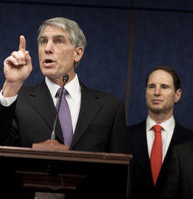
A new statement today from Democratic Sens. Mark Udall and Ron Wyden, in response to claims by senior officials that the broad collection of telephone records by the National Security Agency made public in the past week after exposure in a British newspaper has "thwarted attacks against the United States."
In our capacity as members of the Senate Select Committee on Intelligence, we have spent years examining the intelligence collection operations that have been secretly authorized under the USA Patriot Act. Based on this experience, we respectfully but firmly disagree with the way that this program has been described by senior administration officials.
After years of review, we believe statements that this very broad Patriot Act collection has been "a critical tool in protecting the nation" do not appear to hold up under close scrutiny. We remain unconvinced that the secret Patriot Act collection has actually provided any uniquely valuable intelligence. As far as we can see, all of the useful information that it has provided appears to have also been available through other collection methods that do not violate the privacy of law-abiding Americans in the way that the Patriot Act collection does. [Pols emphasis] We hope that President Obama will probe the basis for these assertions, as we have.
We also disagree with the statement that the broad Patriot Act collection strikes the "right balance" between protecting American security and protecting Americans' privacy. In our view it does not. When Americans call their friends and family, whom they call, when they call, and where they call from is private information. We believe the large-scale collection of this information by the government has a very significant impact on Americans' privacy, whether senior government officials recognize that fact or not.
Finally, we have long been concerned about the degree to which this collection has relied on "secret law." Senior administration officials have stated on multiple occasions that the Patriot Act’s "business records" authority is "analogous to a grand jury subpoena." And multiple senior officials have stated that US intelligence agencies do not collect information or dossiers on "millions of Americans." We appreciate the recent statement from the Director of National Intelligence, which declassified certain facts about this collection, including its breadth. Now that the fact of bulk collection has been declassified, we believe that more information about the scale of the collection, and specifically whether it involves the records of "millions of Americans" should be declassified as well. The American people must be given the opportunity to evaluate the facts about this program and its broad scope for themselves, so that this debate can begin in earnest.
According to defenders of the NSA's program in both parties, the order for these daily dumps of phone records is simply a renewal of similar orders that have been in place for the past seven years. It's worth noting that Udall, as a member of Congress and a U.S. Senator has consistently challenged these programs as a violation of the privacy rights of American citizens–as much as he has been able to without disclosing classified information.
Republicans who defended these data collection programs under the administration of George W. Bush look like fools for condemning the same programs now carried out under President Barack Obama. That said, the political damage from these programs' continued existence (and potential expansion) does fall on Obama, who campaigned on a much more skeptical platform with regard to domestic surveillance.
It looks to us like the only political winners coming out of this may be Mark Udall and Ron Wyden.
Subscribe to our monthly newsletter to stay in the loop with regular updates!
Comments