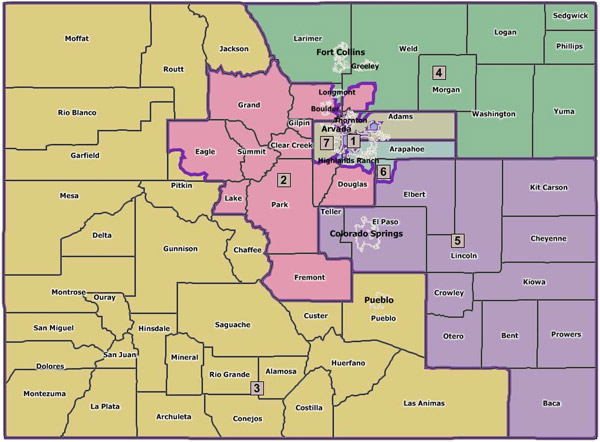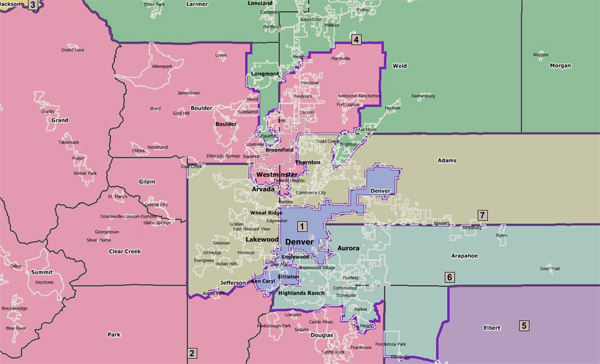
Answering the latest round of proposed congressional redistricting maps from Republicans, Democrats unveiled today a new map they say is the result of discussions with Republicans “at all levels,” and a compromise from their previous “City Integrity” map proposal. While acknowledging feedback they’ve received in the last couple of weeks–“some organic and some produced from partisan groups”–Democrats say this new map still reflects their originally stated guiding principles of competitiveness, integrity of meaningful political boundaries, and preservation of communities of interest.

On a practical level, you can see that this map does represent significant concessions from “City Integrity.” The West Slope is now “whole,” to the extent it ever was without Eagle, Grand and Summit Counties–this always struck us as more of a symbolic than realistic objection. Larimer County remains unspoilt, and the city of Grand Junction’s sacred honor is no longer threatened by Rep. Jared Polis of Boulder. El Paso County is undivided. And now that it’s actually public knowledge where Rep. Mike Coffman wants to live, it looks like Democrats were charitable enough draw his new home into a nonetheless more competitive 6th District. This map also increases GOP representation in swing CD-7 at the expense of registered Democrats.

Overall, the “Colorado Compromise” map appears to clarify and drive home the foremost desired goal of Democrats, which is to create competitive districts: a goal they insist was an overarching theme in public hearings around the state. That said, Democrats have identified six major principles they say any new map should reflect:
1) To equalize population, so that Coloradans in each of the seven districts have an equal voice on the national level making sure we adhere to the principle of one person-one vote.
2) To not dilute any single ethnic minority’s ability to elect a representative of their choosing as dictated under the Federal Voting Rights Act
3) To not split political subdivisions whenever possible, especially county boundaries in rural Colorado and city boundaries along the Front Range
4) To recognize the communities of interest that exist around the state
5) To make districts as compact as physically as possible.
AND
6) To create districts that reflect the politically competitive nature of the state, and does not provide safe seats and congressman for life.
Bottom line: we really get the sense that Democrats would like to make a deal here, even though conventional wisdom suggests they have less to lose than the GOP should the matter end up in court as it historically usually has. This latest Democratic map undeniably represents concessions from their original proposal, and substantially disarms specific points of criticism, valid or not, against which the “City Integrity” maps had proven vulnerable. Though Republicans billed their latest map yesterday–which increases GOP odds in five of seven districts–as the “last best hope” for compromise, perhaps today’s map really is.
The answer to that question…is up to the party with more to lose.
Subscribe to our monthly newsletter to stay in the loop with regular updates!
Comments