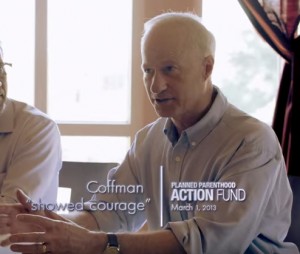
Still from Rep. Mike Coffman’s 2014 ad using Planned Parenthood’s logo.
Colorado’s most vulnerable Republican incumbent in this crazy 2016 election season, Rep. Mike Coffman of Aurora, is without question our state’s greatest political survivalist. Few politicians in our state’s history have had their political constituencies as dramatically reshaped out from under them as Coffman, who was originally elected in 2008 to succeed the hard-right anti-immigrant firebrand Rep. Tom Tancredo. After several years representing Tancredo’s accommodating staunch conservative Republican constituents, Coffman’s congressional district was redrawn to include the highly diverse suburban city of Aurora, and went from an ultra-safe Republican seat to one of the nation’s most competitive.
Coffman’s up-to-now successful ability to re-invent his political image in wholesale terms, winning re-election twice in his new diverse and competitive battleground, stands today as perhaps the biggest disappointment for Colorado Democrats in the twelve years they have enjoyed resurgent control in this state. In 2012, Coffman faced an underfunded challenger who came nonetheless unexpectedly close to unseating him. In 2014, Coffman actually ran to the left of his Democratic opponent Andrew Romanoff on certain issues like immigration, and audaciously used Planned Parenthood’s logo in positive ads despite his repeated votes over the years to cut off the organization’s funding.
And Coffman won. Coffman just kept winning, as Democrats fumed over what they viewed as blatant political opportunism and shameless flip-flopping on formerly core issues for pure political survival. In 2014, the successful U.S. Senate campaign of “Con Man Cory” Gardner, along with Coffman, created something like real despair for Democratic strategists that factual positions, statements, and other such “reality based” lines of attack were losing their efficacy in politics. Here were politicians who lied right through the fact-checking and in the end did not pay a price.
This weekend, though, something happened that we may look back on as the moment Coffman’s audacious political re-invention finally broke down. Two major stories, one in the New York Times and the second in today’s Denver Post, take a second look at Coffman’s changing politics–and in doing so, de-legitimize the whole effort with surprising ease. Here’s the New York Times’Emmarie Huetemann, with her devastating headline “A Congressman Slighted Immigrants, Then Embraced Them. Now He Runs From Trump.”
He started learning Spanish in 2013, he said, shortly after being re-elected to a redistricted House seat whose constituents bore little resemblance to the far more conservative ones who sent him to Congress in 2008. Mr. Coffman, a retired Marine who co-sponsored a bill to make English the nation’s official language and suggested that Hispanic voters who could not understand their ballots should “pull out a dictionary,” suddenly represented the most diverse district in Colorado…
Mr. Coffman’s detractors see him as another pandering politician, willing to do anything to get re-elected. Another of Mr. Coffman’s ads — in which a handful of people of different ages and ethnicities say he is “not like other Republicans” but “one of us” — draws bitter laughter at Ms. Carroll’s campaign office.
“He didn’t find religion until he got redistricted,” said Tim Sandos, a former Denver city councilman who is now the chief executive of the National Hispanic Voter Educational Foundation. “And now all of a sudden he’s ‘one of us.’” [Pols emphasis]
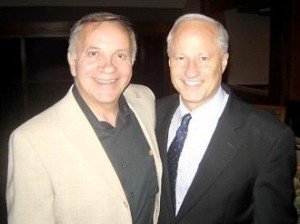
Tom Tancredo, Mike Coffman.
Meanwhile, over Denver Post, reporter Joey Bunch gives Coffman’s long and changing record exactly what Coffman doesn’t want: a thorough and impartial examination.
Opponents concede the congressman has distanced himself from Trump, the candidate, but contend he cannot credibly deny his history of Trump-like statements and Trump-like positions.
The Denver Post analyzed the most common talking points Democrats use to link Coffman and Trump. The Post found that most have some basis in fact, but they lack context to give a better understanding of the issues.
From there, readers are treated to a pretty good summary of what swing voters in Coffman’s district will consider the worst things Coffman has said and done, like claiming President Barack Obama “is not an American” and saying the DREAM Act for undocumented students “will be a nightmare for the American people.” In each case Bunch dutifully includes Coffman’s apology, subsequent policy change, or other “context” as applicable. One item missing from Bunch’s list is the above mentioned use of Planned Parenthood’s logo in Coffman’s campaign ads, which has merited its own story on other occasions.
The context doesn’t help, folks. The aggregate weight of all of Coffman’s reinventions in one place is simply too much. Taking all of Coffman’s “changes of heart” in the only context that matters–Coffman’s quest for political survival–makes the whole exercise look fraudulent. The fact is that none of this is new information, and this is a case that Coffman’s opponents could have made in 2014 with most of the same material. But it’s impossible to read these long form examinations of Coffman’s shifting positions and not conclude that, as Tancredo himself recently said of Coffman, “the only thing authentic about him is his passionate desire to keep that House Member pin on his lapel.”
The difference may be that in this calamitous year for Republicans, Coffman’s reinvention just stands out more. Donald Trump has created a political world of black and white choices for Republicans — a world where it’s next to impossible to be a Republican in the gray area. As we’ve said before, you cannot be publicly ambivalent about Trump, and the GOP Presidential nominee’s line-in-the-sand approach provides little room to maneuver for Republicans such as Coffman.
Coffman’s 2016 campaign is fairly similar to what he’s always done; but by changing the context of this election, Trump is making Coffman’s strategy untenable. There was another way for Coffman, but he missed his exit, and after years of watching Coffman brashly outmaneuver his fate for two election cycles, this feels different to us.


 August 14, 2016 11:05 AM UTC
Comments